
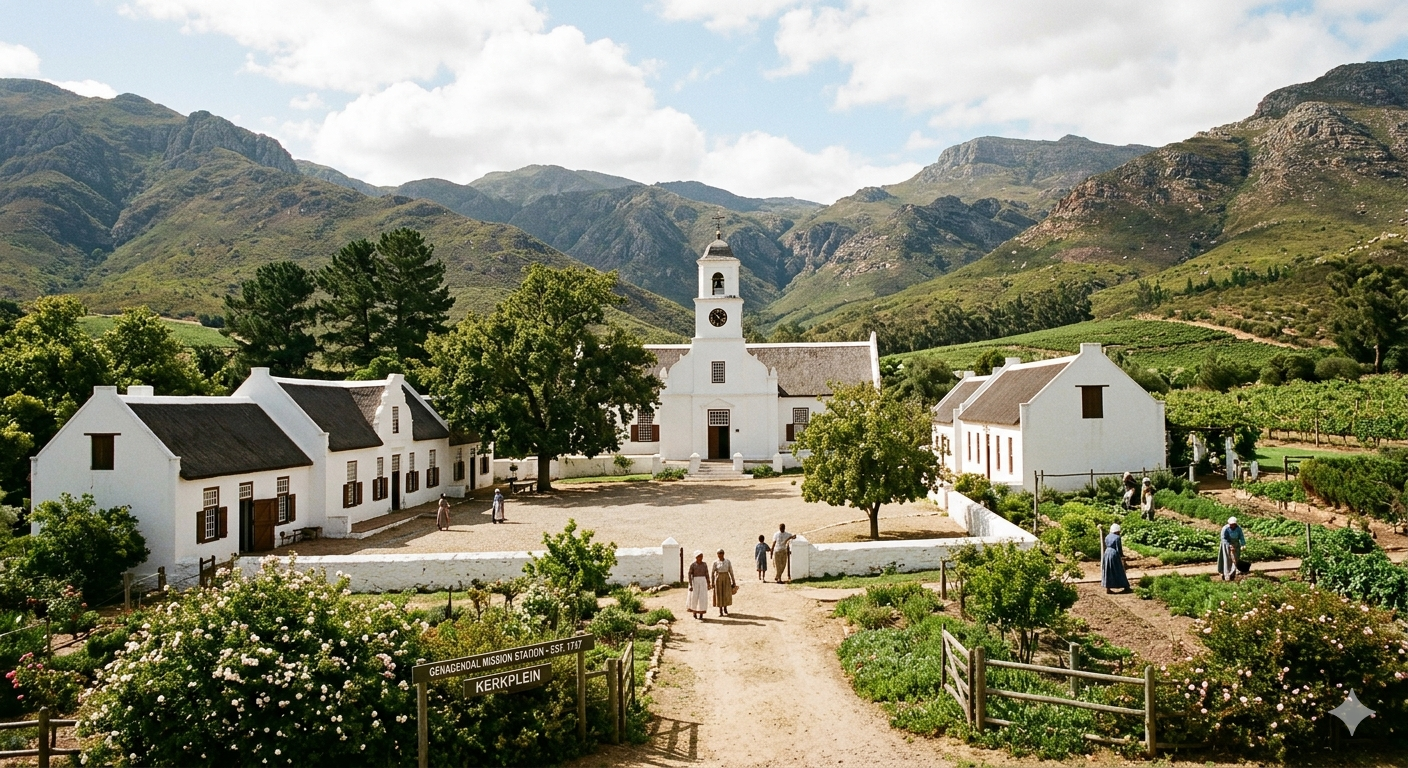
The history of the Christian faith in sub-Saharan Africa is not a story of human might, but a narrative of "extra-ordinary exploits" accomplished by "weak instruments" who answered a heavenly call. These pioneers, famously described by Dr. David Livingstone as "morning-stars shining in the dark," laid the spiritual foundation for what is now recognized as the "new Christendom".
The First Foothold: Grace in the Valley
The formal planting of Protestant missions in South Africa began in 1737 at Genadendal (the Valley of Grace). The mission was established by Georg Schmidt, a German Moravian and former butcher’s apprentice, who sought to minister to the Khoi tribe.
A lasting symbol of this era is the Pear Tree Schmidt planted in 1738. Though Schmidt faced intense opposition from local authorities, his work sowed seeds that continue to bear fruit. When the original tree eventually died, a new shoot sprung up from the roots—a powerful testament to life rising from death and the enduring nature of faith.
Explorers, Translators, and the "Smoke of a Thousand Villages"
In the 19th century, the London Missionary Society (LMS) became a driving force for opening the African interior. Key figures emerged who combined physical stamina with intellectual devotion:
- Robert and Mary Moffat: A former gardener, Robert Moffat spent over 50 years in mission. In 1857, he became the first to translate the Bible into an African language (Setswana). His wife, Mary, was a "nobler, truer helpmeet" who often managed the mission station alone during his travels.
- David Livingstone: Inspired by Moffat’s description of the "smoke of a thousand villages where no missionary has ever been," Livingstone arrived in 1840. Known as the "Apostle of Africa," he sought to end the slave trade and explore the continent. He died in 1873 in present-day Zambia, famously leaving his heart buried under an African mvula tree.
Heroines of the Faith
Women pioneers often faced "manifold pain and sorrow" to bring the Gospel to unreached regions.
- Mary Slessor: A Scottish mill worker inspired by Livingstone’s legacy, Slessor became the "White Queen of Calabar" in Nigeria. She was known for brokering peace between warring factions and rescuing hundreds of twins from ritual sacrifice.
- Mary Mozley: A trained nurse serving in the Belgian Congo, Mozley wrestled with the linguistic challenge of creating a Biblical vocabulary for concepts like "justification" and "faith". Her life ended early in 1923, marked by a deep "fellowship of sympathy" with the people she served.
Indigenous Giants and the Modern Church
The missionary movement was never merely a foreign import; it was carried forward by African "trophies of grace".
- Early Leaders: William Kama was the first chief in the Eastern Cape to publicly acknowledge his Christian faith.
- 20th Century Revival: Figures like Pastor William Duma in Durban and William Nagenda of Uganda—a key leader in the East African Revival—called the church to be filled with the Holy Spirit to meet the world’s needs.
Today, this legacy lives on through leaders such as Archbishop Siegfried Ngubane, the current presiding Bishop of REACH-SA. Having previously served as the South African director of SIM (Serving In Mission), Ngubane represents a new generation of African leadership standing for the "Word of Life".
As David Livingstone once predicted, "Africa’s Day is yet to come". The work of these pioneers remains the bedrock of that hope, reminding us that God uses the humble to accomplish the eternal.