
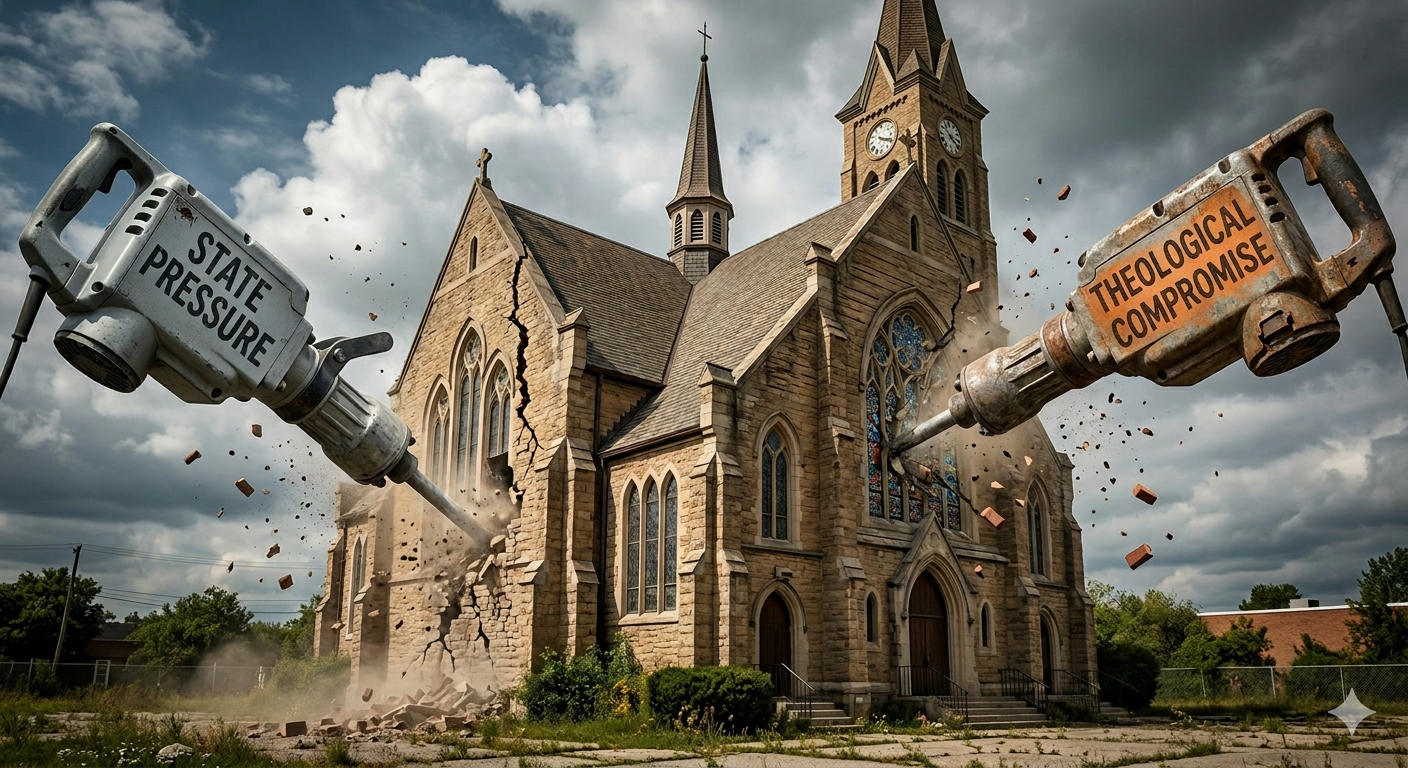
In the heart of South Africa, a quiet but serious crisis is unfolding within some of the country’s historic Protestant churches. What has been described as a “Church Downgrade” is not a sudden collapse, but a steady and accelerating drift—from biblical clarity to theological uncertainty, from conviction to accommodation.
This is not merely a matter of institutional change. It is a question of authority, truth, and the future of the Gospel itself.
By early 2026, the Protestant Association of South Africa identifies a twofold pressure: a gradual erosion from within the church, and an increasing pressure from outside it.
Erosion from Within
The most concerning development is not external hostility, but internal drift.
In recent years, questions once settled within Protestant orthodoxy are being reopened. The exclusivity of Christ, the authority of Scripture, and the nature of salvation are no longer consistently affirmed with clarity. What emerges instead is a softened theological posture—one that avoids offence, accommodates uncertainty, and leaves room for multiple interpretations where Scripture speaks plainly.
A widely discussed example arose in 2024, when a senior church leader publicly suggested that those without explicit faith in Christ may not necessarily be lost. Though carefully worded, such statements signal a deeper shift: from the clear proclamation that salvation is found in Christ alone (John 14:6), to a more open-ended hope grounded in human sincerity.
This is not a minor adjustment. It strikes at the heart of the Gospel.
At the same time, other influences contribute to this drift. Movements that emphasise experience over doctrine, atmosphere over truth, and accessibility over precision have gained significant ground. While often well-intentioned, they frequently result in a subtle reshaping of biblical language. Sin is softened, repentance is muted, and the offence of the cross is reduced.
Even theological education has not been immune. Institutions once committed to the defence of Reformed doctrine are, in some cases, broadening their identity in ways that reflect the spirit of the age more than the authority of Scripture.
The pattern is familiar in church history. When Scripture is no longer allowed to speak with full authority, decline follows—quietly at first, but inevitably.
Pressure from Without
Alongside internal drift, there is growing concern regarding external control.
Proposals linked to the CRL Rights Commission have raised the possibility of increased regulation of religious bodies. While such efforts are often motivated by a desire to address genuine abuses, they carry a deeper risk: the gradual subordination of the church to the state—what has historically been termed Erastianism.
The issue is not whether wrongdoing should be addressed, but who ultimately governs the church. When the state assumes authority over doctrine, ministry, or ecclesiastical practice, the independence of the church is compromised.
This concern is not theoretical. History repeatedly demonstrates that when the church yields its authority to external structures, it loses not only its freedom, but its voice.
Visible Fractures
These pressures are no longer abstract.
Divisions within denominations, strained relationships between churches, and growing uncertainty among believers all point to a deeper instability. Decisions taken in recent years—particularly on matters of doctrine and church practice—have already led to separation and realignment within the broader Reformed community.
Such fractures are not the cause of the crisis, but the symptom of it. Where there is no longer agreement on the authority of Scripture, unity cannot be sustained.
A Moment of Decision
This moment is not without precedent. Church history bears witness to similar periods of decline, where doctrinal clarity was gradually replaced by ambiguity, and conviction gave way to compromise.
The lesson is consistent: when the foundation is weakened, the structure will not stand.
For many ordinary believers across South Africa, this issue is not abstract. It concerns what will be taught in their churches, what their children will hear, and whether the Gospel they have received will remain intact.
The response required is not panic, nor reactionary division. It is something both simpler and more demanding: a return to the authority of Scripture—not merely confessed, but obeyed. Scripture must once again be allowed to govern doctrine, shape preaching, and bind the conscience.
This means recovering clarity on the central truths of the Gospel: that Christ alone saves, that grace alone justifies, and that truth is not subject to negotiation. It also requires courage—courage to resist internal pressures to conform, and external pressures to submit where Christ alone is Lord of the church.
The question is no longer whether change is taking place. That is evident. The question is whether the church will recognise the moment for what it is—and respond accordingly.
“We ought to obey God rather than men.” (Acts 5:29)
Where the Word of God governs, the church stands. Where it is set aside, decline—however gradual—has already begun